


Complete Bravo Sterndrive vs Upper vs Lower Unit
Complete Bravo Sterndrive vs Upper vs Lower Unit
Once you've confirmed your Bravo drive family and gear ratio, the next decision is choosing the right replacement level: a complete Bravo sterndrive, an upper unit only, a lower unit only, or a transom assembly. Picking the wrong scope means either overspending on parts you don't need, or underspending and ending up back in the shop. This guide breaks down when each option makes sense.
Understanding the Bravo Drivetrain Layout
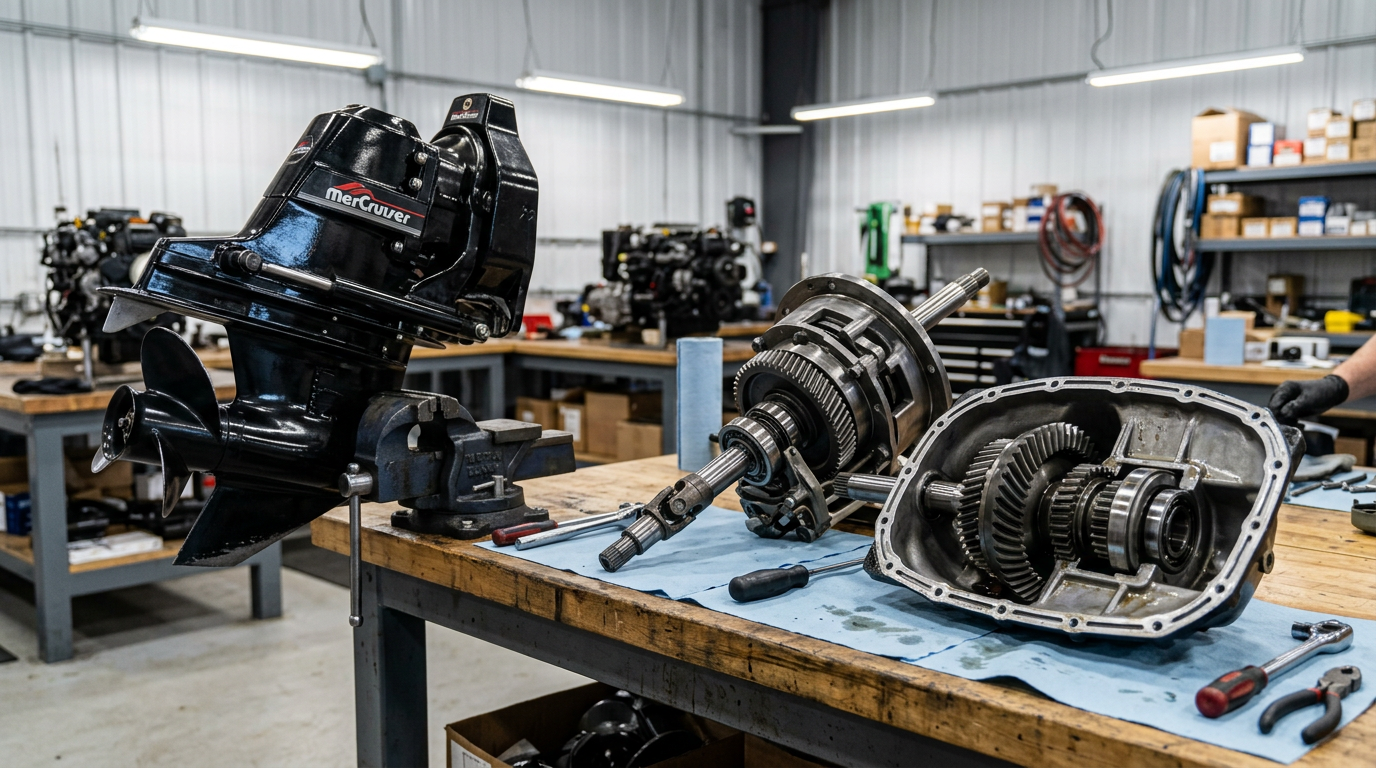
A Bravo sterndrive is built from several major assemblies working together: the upper unit (connecting to the engine and housing the upper gear set), the lower unit (housing the propeller shaft, lower gears, and — on Bravo Three — the dual counter-rotating gear set), and the transom assembly (mounting the drive to the boat's hull). Diagnosing exactly which assembly has failed determines how much of the drivetrain actually needs replacing.
When a Lower Unit Replacement Is Sufficient
If the upper unit and transom assembly are in good condition, but the lower unit shows cracked housing, worn propeller shaft splines, water intrusion, or damaged lower gears, a lower-unit-only replacement is typically the most cost-effective repair. This is especially true for Bravo One and Bravo Two, where the lower unit is a well-defined, separable component. On Bravo Three, a lower unit replacement must include the correct dual counter-rotating gear set to maintain proper propeller rotation.
When an Upper Unit Replacement Makes Sense
If your lower unit is functioning correctly and matches your confirmed gear ratio, but you're experiencing upper gear noise, input coupler wear, or shift mechanism issues at the top of the drive, an upper-unit-only replacement can resolve the problem without the added cost of a complete drive. This approach depends on being able to confidently confirm that your existing lower unit's gear ratio and rotation type match the replacement upper unit exactly.
When to Consider the Transom Assembly
The transom assembly is what physically mounts the sterndrive to your boat's hull and houses the gimbal bearing, bellows, and steering connections. If you're experiencing water intrusion around the transom, worn bellows, or steering play unrelated to the drive itself, the transom assembly — rather than the upper or lower unit — is often the actual point of failure and should be inspected separately.
When a Complete Sterndrive Replacement Is the Better Call
- Both upper and lower units show significant wear or damage
- You cannot confidently verify the gear ratio or rotation type of your existing components
- The drive has an unknown service history or shows signs of a prior mismatched repair
- You're converting between Bravo One, Two, or Three configurations
- You want a fully matched, factory-correct assembly without independently verifying compatibility between separate components
Key Takeaway: Replace only the assembly that's actually diagnosed as failed — but never assume compatibility between a new component and existing ones without verifying drive family, gear ratio, and rotation type first.
Decision Guide
| Diagnosed Issue | Recommended Replacement |
| Lower unit damage, upper unit healthy | Lower unit only |
| Upper gear noise, lower unit healthy | Upper unit only |
| Bellows wear, water intrusion at transom | Transom assembly |
| Multiple failures or unverified specs | Complete sterndrive replacement |
Frequently Asked Questions
Can I mix a new lower unit with my existing upper unit?
Yes, as long as the gear ratio and rotation type match exactly between the two components — this is especially critical on Bravo Three's dual counter-rotating gear set.
Is a complete sterndrive always the safer choice?
It removes fitment guesswork, but it's not always necessary. If you can confidently verify your existing components' specs, a targeted upper or lower unit replacement is often more cost-effective.
Not sure whether you need a complete drive, upper unit, or lower unit? Contact our team for a fitment recommendation.